Consultancy service
Cloud & EUC modernisation
Enterprise EUC and cloud platform modernisation across AWS, Azure, WorkSpaces, AVD, Intune, Citrix, MECM and Terraform.
The problem
Enterprise desktop and cloud platforms age in place. A virtual desktop estate that served the business well a decade ago becomes a drag on delivery: slow to change, expensive to run, difficult to secure and increasingly hard to explain. The people who built it have often moved on, and the documentation rarely kept up.
Modernisation usually stalls not because the target platform is unclear, but because the current one is not understood well enough to leave safely. The work is as much discovery and dependency mapping as it is engineering.
Typical situations
- A legacy EUC estate that has outlived its design and its documentation.
- A move from on-premises Citrix or VDI to cloud desktops such as AWS WorkSpaces or Azure Virtual Desktop.
- A platform rebuild where the infrastructure needs to become code before it can be trusted.
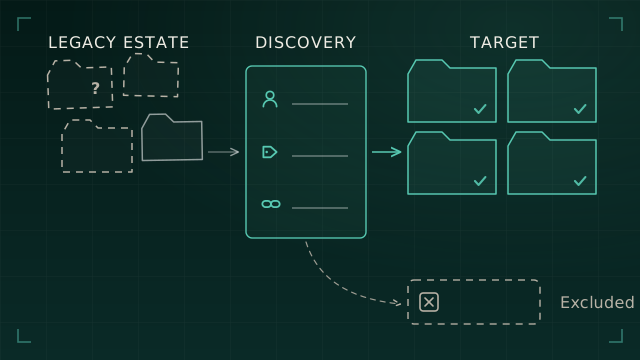
- A controlled decommission that has to preserve load-bearing file and dependency paths.
- Operational clean-up after years of quick fixes and inherited exceptions.
How the work runs
- 01
Understand the estate
Read-only discovery of the current platform: images, applications, connections, dependencies and the exceptions nobody wrote down.
- 02
Design around how people work
A target platform shaped by real usage rather than the old design, secure by default and buildable from code.
- 03
Build as code
Terraform-defined environments with remote state, repeatable images and pipelines, so the platform can be rebuilt rather than restored.
- 04
Migrate in controlled stages
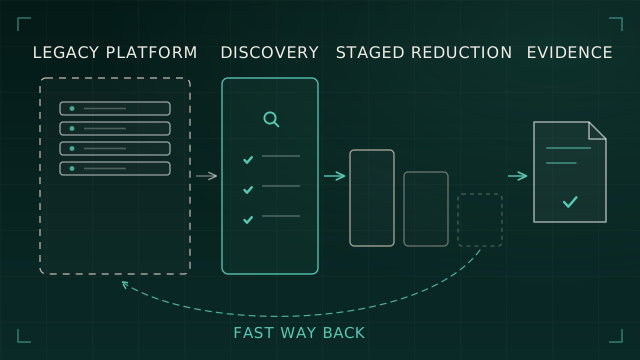
Users and workloads move in planned groups with rollback points and evidence at each stage.
- 05
Retire the old platform properly
Decommissioning with dependency checks, retained evidence and a clean handover to operations.
Risks and decisions
Risks to control
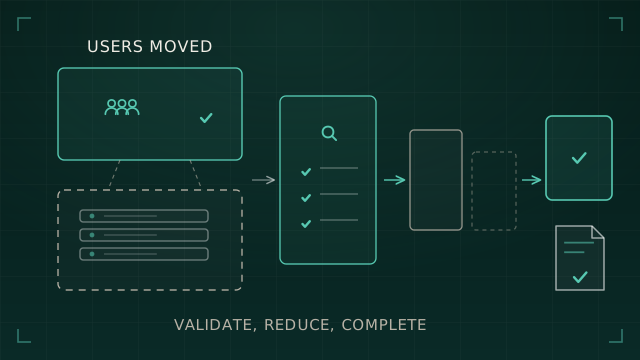
- Users moved while file, print and application dependencies still resolve through the legacy estate.
- Two management planes running at once, each holding a partial truth about the same devices.
- A rollback window that closed before the new platform survived month-end, or never formally closed at all.
- Retained services left running on infrastructure that was supposed to disappear.
- Legacy licences and infrastructure cost renewing quietly after the users have moved.
Decisions to settle
- What counts as completion, written about the platform rather than the users.
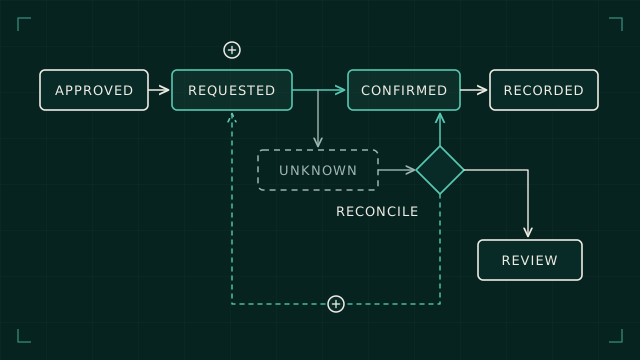
- When rollback closes, and who is entitled to close it.
- Which services move, which are replaced and which retire with the platform.
- Which management plane becomes authoritative, and when the old one is retired.
- When and how the legacy estate reduces, stage by stage with a way back.
What you get back
- 01Estate discovery report
- 02Dependency and risk map
- 03Target platform design
- 04Terraform codebase and build pipelines
- 05Migration plan with rollback points
- 06Controlled decommissioning record
- 07Operational handover pack
Delivered evidence
Featured enterprise engagement
AWS EUC modernisation: Windows 11 WorkSpaces built as code, legacy Citrix estate decommissioned
A major UK insurer needed to modernise an AWS EUC estate, replacing a legacy Citrix-on-EC2 developer desktop platform with a Windows 11 AWS WorkSpaces environment.
- Built the Terraform codebase for five Windows 11 WorkSpaces environments, including secure dev, test and prod estates connected to a secure data lake.
- Delivered the supporting management portal stack using ALB, API Gateway, RDS Multi-AZ and EC2 as independent root modules with remote S3 state.
- Migrated the MECM primary site server cross-account by AMI / snapshot lift-and-shift.
- Built EC2 Image Builder pipelines for high-spec Windows Server 2022 application hosts.
100%
80+
Zero
Supporting evidence