Consultancy service
AI-assisted discovery and delivery
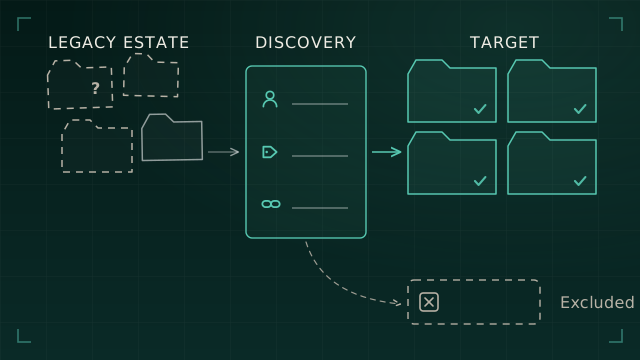
AI-assisted methods for discovery, documentation, classification, duplicate analysis, dependency mapping, test planning, evidence packs and remediation planning.
The problem
Most enterprise estates are too broad, inconsistent and undocumented for manual review alone. The practical result is that discovery gets scoped down, documentation is skipped and decisions are made on samples rather than evidence.
AI-assisted methods change the economics of looking. Used with discipline they widen coverage dramatically; used carelessly they produce confident drafts that are wrong in ways that read as right. The difference is the operating model around them.
Typical situations
- An estate too large or too messy for manual discovery to be affordable.
- Documentation that has to be produced from evidence, not from memory.
- Classification, duplicate analysis and dependency mapping at scale.
- Test planning and evidence packs for regulated or audited change.
- A team that wants AI acceleration without surrendering engineering judgement.
How the work runs
- 01
Gather
Point the tooling at evidence collected read-only from the environment.
- 02
Draft
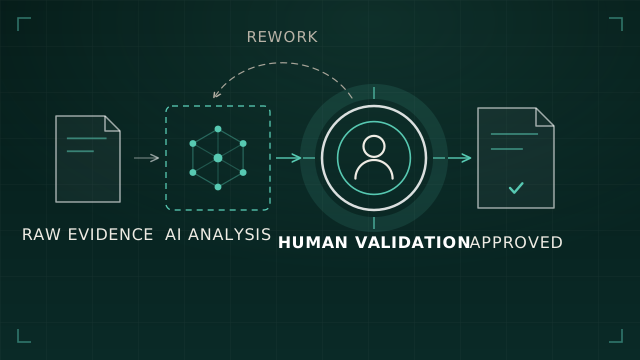
Let AI-assisted analysis produce the first version of the map, the classification or the document.
- 03
Validate
Check the draft against reality, sampling hardest where a mistake would hurt most.
- 04
Record the workings
Note what was checked and what was corrected, so every evidence pack shows how it was made.
- 05
Act with sign-off
Only then plan action, with decision points owned by people, not tools.
Risks and decisions
Risks to control
- Material submitted for analysis that should never have left the environment.
- Output trusted because it reads well, not because it was checked.
- Findings treated as decisions instead of evidence for them.
- Corrections made silently, so the evidence pack no longer shows its workings.
- Automation acting on production without a human having agreed it.
Decisions to settle
- Which material may be processed, and on what terms.
- Where AI genuinely widens coverage, and where it only adds words.
- What gets sampled by hand, hardest where a mistake would hurt most.
- Which findings are accepted, corrected or rejected, and by whom.
- When output is strong enough to act on, and when it is not.
How information is handled
AI-assisted analysis uses selected business or API services, including Anthropic Claude and OpenAI services where they fit the engagement. Which information they may see is a decision, made with you, before anything is submitted:
- What is analysed is agreed first, and the handling and retention position is recorded before any material is submitted.
- Passwords, credentials, access tokens, private keys and other secrets are excluded from AI workflows.
- Personal and sensitive information is minimised, and redacted or pseudonymised where practical before external processing.
- Client material reaches an external provider only with your agreement, on business or API terms checked as suitable for the engagement.
- Source material and outputs are retained only for the work they support, and provider handling and retention terms are checked first.
- A no-AI route is available: the same work can proceed on conventional analysis and documentation methods.
- NDAs and appropriate data-processing terms are available where the engagement requires them.
What you get back
- 01Discovery reports produced at estate scale
- 02Classification and duplicate analysis
- 03Dependency maps with named owners
- 04Documentation drafted from evidence and verified against the live environment
- 05Test plans and evidence packs
- 06A working model your team can keep using
Supporting evidence