Cloud and EUC
Infrastructure technical debt is a problem of changeability
An old component is not automatically the biggest liability. The more useful question is how confidently the platform can be changed, supported and recovered.
Infrastructure debt is often presented as an age report: old operating systems, old appliances, old management tools. That inventory matters, especially where support or security exposure is involved. It still leaves an important part of the problem unmeasured.
A relatively new platform can be difficult to change because nobody understands its dependencies, its configuration is maintained in several places or its recovery process has never been exercised. An older but supported component may have clearer ownership and a well-tested operating model.
I would assess infrastructure debt through changeability: the effort and uncertainty involved in making a controlled change, operating the resulting service and recovering when something goes wrong. Age contributes to that assessment, but it should not substitute for it.
Separate the liabilities
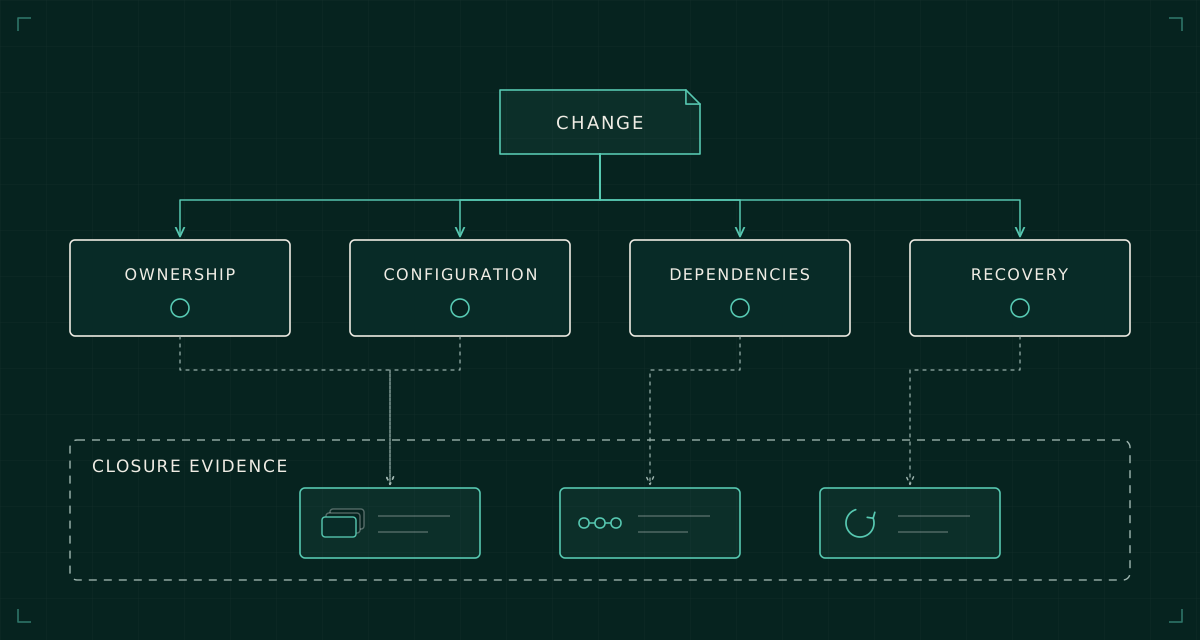
Support debt concerns whether the component has a viable maintenance and security path. Configuration debt concerns how reliably its intended state can be established. Dependency debt concerns the systems that rely on it, especially where those relationships are undocumented.
Recovery debt appears when restoration depends on assumptions rather than evidence. Ownership debt appears when the organisation cannot identify who is responsible for a decision or operation. Skills concentration is another liability: a platform may function well while depending on one person's undocumented knowledge.
These liabilities interact. A renewal decision can become expensive because the dependent applications are unknown. An upgrade can stall because the only recovery route is an untested backup. A security correction can be delayed because nobody can establish which team owns the exception.
Use those categories to explain the debt, rather than collapse everything into a single red status. Different causes require different work and can often be reduced independently.
Test a realistic change
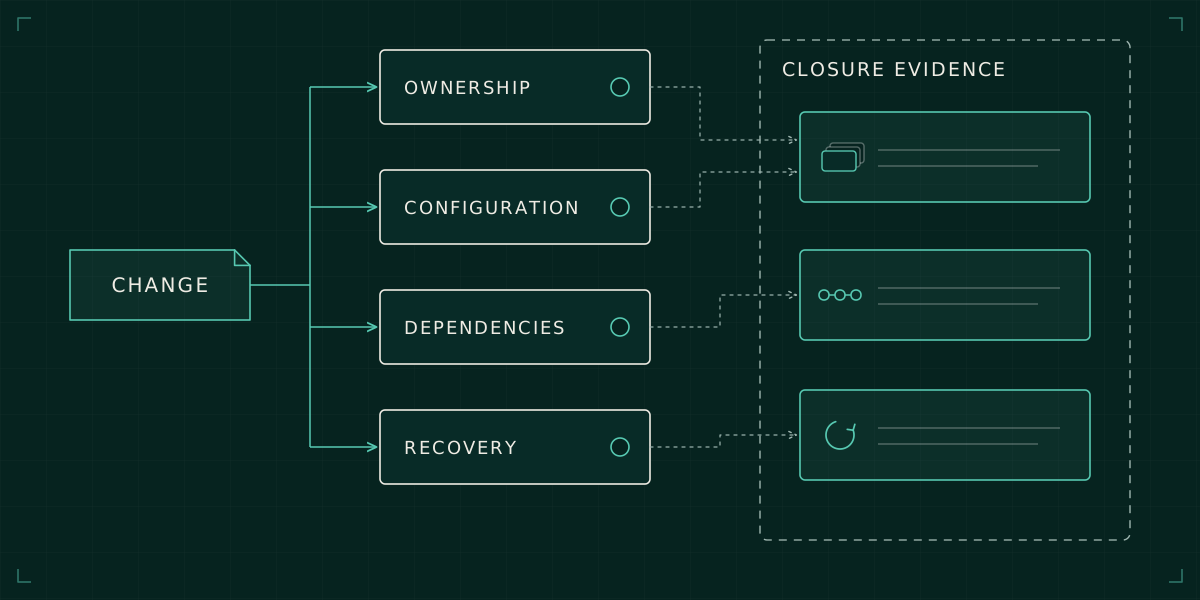
Choose a change that matters to the service: rotating a certificate, replacing a host, updating a base image or altering a network route. Ask what evidence would be needed to perform it safely.
Can the affected resources be enumerated? Is the current state known? Are the dependencies documented? Can the change be reproduced outside production? Is recovery defined, including the data and identity requirements that make it possible?
The exercise can remain read-only initially. Its value is in locating uncertainty. If the team spends most of its preparation time discovering ownership and searching for configuration, that is evidence of debt even when no component has reached the end of support.
Record preparation effort and unresolved questions. A short rehearsal can reveal more about the platform's condition than a broad dashboard that counts ageing assets without explaining their operational consequence.
Recovery evidence changes the priority
A backup record demonstrates that a backup process ran. It does not establish that the service can be recovered with the required data, configuration, credentials and dependencies.
Test restoration against the service requirement. Include the sequence in which dependencies must return and the authority required to restore them. A workload recovery that relies on an unavailable identity system or an inaccessible encryption key may fail before the application itself is reached.
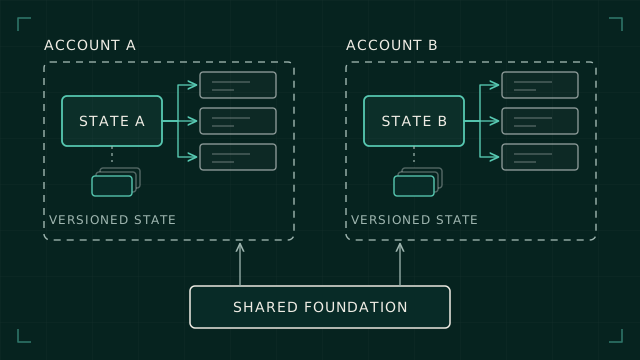
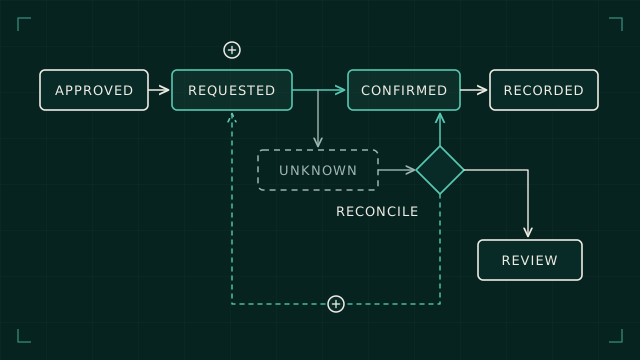
For infrastructure as code, recovery includes the control data and tooling as well as the resources. Terraform's S3 backend guidance describes versioning and locking facilities; the operational design must still establish how recovered state is reconciled with live resources.
This connects directly to state ownership in enterprise AWS. The debt is reduced when another authorised engineer can use the recovery procedure successfully, not when a document lists the right product features.
Rank consequences, effort and uncertainty
A useful prioritisation record should describe the business consequence of leaving the debt, the likely effort to reduce it and the confidence in both assessments. Those are different dimensions.
For a hypothetical shared certificate, the consequence may be service interruption if renewal is missed. The effort may be modest once consumers are identified. The uncertainty may be high because several undocumented systems use it. The immediate work could therefore be discovery, followed by ownership and an exercised renewal process.
Compare that with an obsolete server hosting a known, replaceable application. Its support exposure may demand urgent action even though its dependencies are clear. A new cloud workflow with broad credentials and no recovery path could also deserve high priority despite its recent deployment.
Avoid pretending that an arbitrary numerical score is a precise prediction. Use scoring only to support a discussion whose assumptions remain visible. Mandatory remediation and known deadlines should remain explicit rather than disappear inside an average.
Turn the finding into a deliverable
“Improve documentation” is difficult to close. “Document and rehearse certificate renewal for these consumers, with a named owner and expiry alert” is a bounded outcome.
The same applies to configuration. “Move the estate into code” is a programme. “Adopt this component into a controlled state boundary, demonstrate a no-surprise plan and test recovery” is a deliverable that can reduce a specific liability.
Define the evidence that will close each item. It may be a supported release, a successful recovery exercise, an authoritative inventory or a transferred operational procedure. Keep the closure test tied to the original risk so that activity does not become a substitute for improvement.
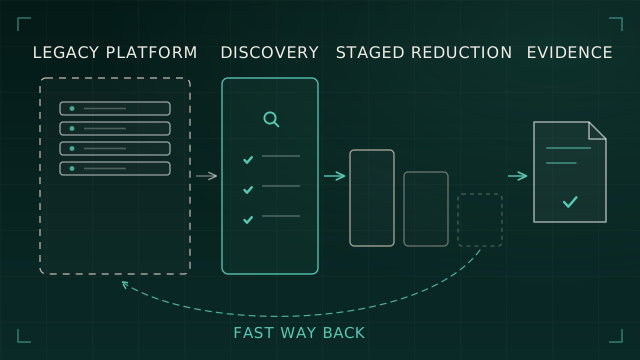
Where dependencies are uncertain, assign investigation work before promising a replacement date. Where a component is truly no longer needed, controlled decommissioning may remove the liability more effectively than upgrading it.
Reserve capacity for the operating model
Debt work competes with visible features and urgent incidents. If it remains optional, the estate can accumulate the same uncertainty faster than the team removes it.
Make relevant debt reduction part of ordinary change. A new application should arrive with ownership and recovery requirements. A migration should close obsolete management paths. An incident correction should reconcile emergency configuration with the declared state rather than leave a permanent exception behind.
AI-assisted analysis can help assemble inventories and identify possible relationships, but its findings need validation. A generated dependency map is a useful starting point only when its evidence and unknowns remain visible. Treat confident guesses as investigation items, not as established architecture.
The useful result is a platform where routine changes demand less rediscovery and recovery depends on fewer assumptions. Infrastructure debt is being reduced when the next engineer can act with a clearer understanding of consequence, ownership and the way back. That is a stronger measure of progress than the average age of the servers.