Technical assurance
Enterprise automation: design for the step that fails halfway
A workflow that crosses identity, infrastructure and business systems will eventually stop between steps. Its design needs to say what has happened and what is safe to do next.
Consider a hypothetical onboarding workflow. It creates an identity, assigns access, provisions a desktop, records the allocation and notifies the requester. Each step works in isolation. The workflow still has an awkward question: what should happen when the desktop is created but the allocation record cannot be saved?
Running the whole script again may create another desktop. Reversing everything may remove access the user has already started using. Doing nothing leaves an asset with no accountable record.
This is where enterprise automation becomes a system-design problem. The useful design describes partial completion, dependencies and recovery, not just the successful sequence of commands.
Map consequences as well as prerequisites
A dependency map should distinguish “must exist before” from “must remain available during”. An identity may be required before provisioning starts. A records service may need to remain available to confirm ownership. An email service may be desirable without being necessary for the core operation to complete.
That distinction helps avoid giving every failure the same response. A failed notification should not necessarily undo a valid allocation. A failed authorisation check should stop the operation before an asset is created.
Record the owner and authority of each system. Which service establishes that the request is approved? Which holds the authoritative allocation? Which can tell you whether a create request actually succeeded? Without those answers, the workflow can accumulate several conflicting versions of the truth.
This extends the relationship-led approach in the existing data-sprawl article. Automation needs to understand what connects the systems before it starts changing them.
Make workflow state explicit
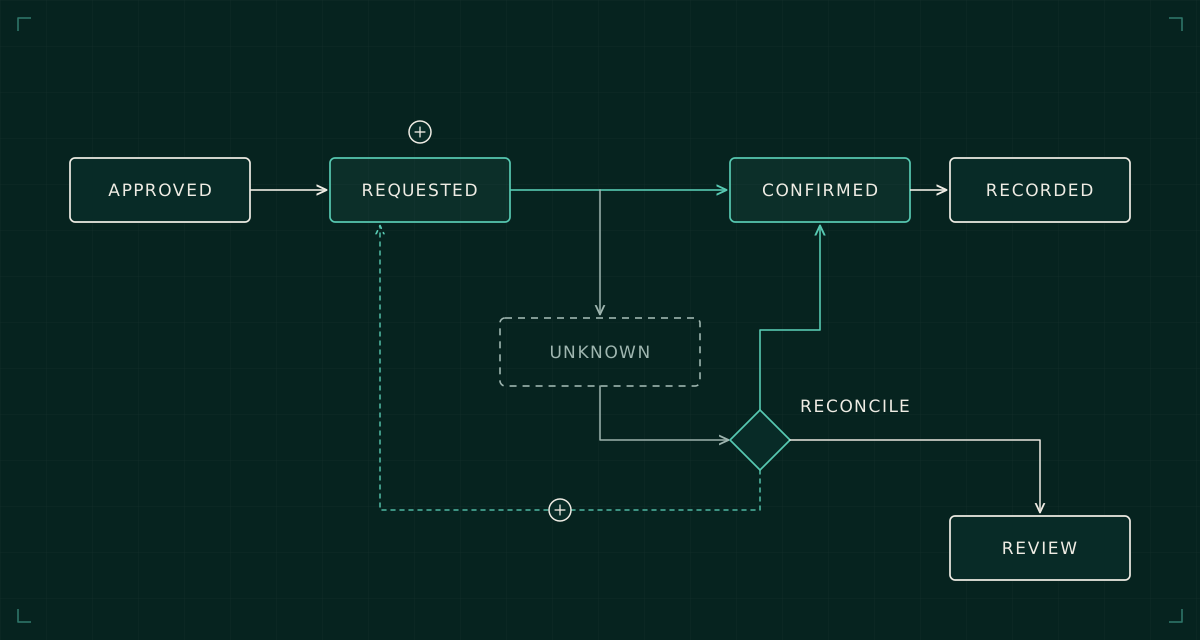
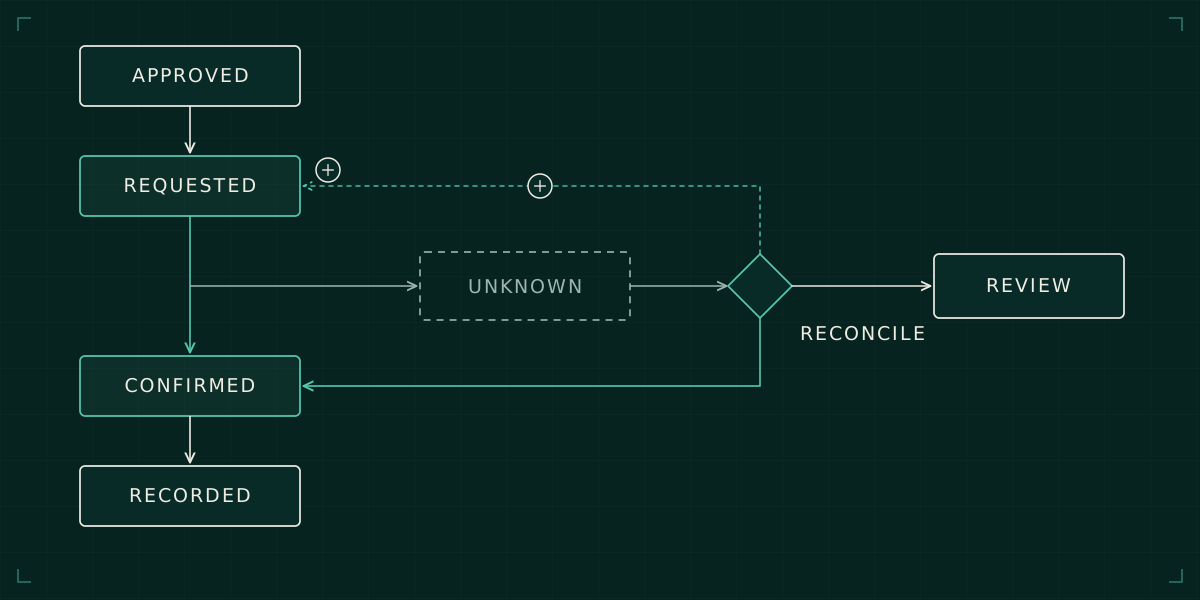
Use states that describe observed facts: requested, approved, provisioning submitted, resource confirmed, allocation recorded and notification pending. Avoid a single success flag that can only describe the entire run.
Persist the request identity, relevant resource identifiers, timestamps and evidence needed to resume. Keep secrets out of that record. The state should let an operator determine what happened without replaying the workflow experimentally against production.
Separate intent from confirmation. “Provisioning requested” does not mean “desktop exists”. Likewise, a timeout does not mean “nothing happened”. A remote system may have completed the operation after the caller stopped waiting.
That unknown outcome deserves its own treatment. Reconcile using the request identifier or a supported query before deciding whether to retry. If the service cannot establish the outcome reliably, route the case for controlled investigation rather than making an unsafe guess.
A retry is another attempt to change reality
Retries are useful for transient failures. They are dangerous when the repeated operation can create an additional effect. The AWS Builders' Library discussion of idempotent APIs explains why caller-supplied request identifiers can make retries safer.
Use a stable operation key across attempts for the same intended action. Generating a new key each time the workflow restarts defeats that purpose. Also define what happens when the same key appears with different parameters: a request for one resource should not silently become a request for another.
Idempotency must reach the side effect. Recording that a workflow has started is insufficient if the resource creation can still happen twice before completion is recorded. Prefer a provider's supported idempotency mechanism where available; otherwise design reconciliation and uniqueness controls appropriate to the system.
Decide which errors are retryable. Authentication failure, invalid input and exhausted entitlement generally need a different response from a temporary service interruption. Set a bounded retry policy with backoff, rather than looping indefinitely and increasing pressure on a failing dependency.
Compensation is a new business action
Across independent services, there may be no transaction that rolls everything back atomically. A compensating action can reduce the effect of a completed step, but it is not necessarily its perfect inverse.
If a desktop exists but its record could not be saved, deleting it may be appropriate before the user has access. After it has been used, deletion could destroy work. The compensation decision therefore needs current state and business rules, not simply the index of the last successful command.
Define automatic compensation only where its safety is understood. Other cases should stop with a clear record and a named recovery procedure. That is not a failure of automation; it is a deliberate limit on its authority.
Compensation can fail too. Record its result separately and preserve the unresolved case. A workflow that reports “rolled back” after one cleanup step timed out is giving the operator an incorrect account of the estate.
Choose orchestration around the operating problem
A scheduled script may be enough for a bounded task with clear reconciliation and modest execution time. A durable workflow engine becomes useful when the process needs persisted progress, waits, retries and visibility across several services.
AWS Step Functions provides error handling through retry and catch behaviour. Those facilities help express control flow. They do not establish whether a repeated business operation is safe; that still depends on the participating services and the workflow's design.
Choose the tool after defining the failure cases. Otherwise the team can build an attractive state-machine diagram that has no reliable answer to an unknown create result or a partially completed compensation.
Operate the exceptions deliberately
An exception queue should show the current state, last confirmed action, reason for stopping and permitted recovery choices. Give operators enough context to avoid creating a second request when they meant to resume the first.
Test interruption after each consequential step. Include a timeout after a successful remote action, a duplicate event, a delayed callback and a failed compensation. Verify the final state in the target systems, not only the workflow's completion message.
Measure unresolved cases and the effort required to reconcile them. A high successful-run count can coexist with a small but expensive population of stranded resources. The design should make those cases visible before they become an inventory project.
Good automation leaves an understandable trail through imperfect systems. When a step fails halfway, another engineer should be able to establish what exists, what remains authorised and what can safely happen next. That capability is part of the workflow, not an operational workaround added after launch.